
A dormant relationship is not a dead one. It’s just one nobody has had a reason to restart.
Many firms never try to revive these leads because the only approach they can think of is an awkward email asking how things are going. When that email inevitably does not get a response, they mark the relationship as “lost” and move the contact to a dormant list.
The thing is, that list is probably worth more than their entire new business pipeline.
What is client reactivation?
Client reactivation is reaching out to a past client, a stalled prospect, or a lapsed contact with a specific reason to revive the engagement. This reason is often something that just happened in their world and changed what they need.
We call that a signal.
A reactivation note offers something, and that offer is only credible because something happened that makes it relevant today.
How to bring back old customers
You bring back an old customer by giving them a reason to reply that did not exist before. That reason is something that changed in their world, connected to something you have already done for somebody like them.
These are the four steps we recommend to start the process:
- Build the list first. Every contact with no activity in 90 days or more. Past clients, stalled proposals, deals that went quiet. Most firms are surprised by the size of it.
- Find a signal for each one. A promotion, a funding round, a new office, a hire, an acquisition, an award. Something dated and public.
- Pair it with proof. One specific result you delivered that is relevant to what just changed. Not a capabilities list.
- Reference the relationship, briefly. The earlier conversation, the project, the introduction. One line, then one short ask.
Signal, proof, context. Miss any of the three, and it reads as a pitch (which is what it is, but people do not always respond well to cold pitches).
How do you reengage lapsed clients without being weird about it?
“Just checking in” is awkward because it asks the reader to supply the reason for the conversation. They have to work out why you sent an email, what you want, and whether they owe you a reply. Most people just don’t reply (we all have hundreds of those emails in our inbox).
A note that opens with something that happened to them removes all three problems at once. They know why you wrote, they know it is recent, and they can tell in one line whether it is relevant.
The discomfort is not irrational. Seventy-three percent of B2B buyers actively avoid suppliers who send irrelevant outreach (Gartner, 2025).
What to do when a client ignores you
First, assume nothing is wrong. Silence after a proposal usually means the priority moved, the budget moved, or the person who cared about it moved.
Second, stop following up on the old thread. Every “just bumping this up” adds pressure to a decision they already deferred and makes the next message harder to send.
Third, wait for something to change and write about that instead. A new quarter, a new hire in the relevant seat, a company milestone. The old proposal becomes context rather than the subject.
We watched this on a $400K proposal at Commercial Lending X that had gone quiet for eight months. One message, built on a signal, put it back in motion with a reply inside seven minutes. Nothing about the proposal changed. The reason to talk did.
Signal-based notes versus checking in
| Checking in | A signal-based note | |
| Opens with | You | Them |
| The reason to reply | Politeness | Something that just happened |
| What it asks for | Attention | Twenty minutes about one thing |
| What it proves | You remember them | You have been paying attention |
| Typical outcome | Silence, and a harder next email | A reply, or a clean no |
The difference is the timing, and timing is the only part of this that can be systemized.
Here is the same contact written both ways:
The check-in
“Hi Mark, hope you are well! Just checking in to see how things are going on your end. Would love to catch up if you have time. Let me know.”
Nothing in that is wrong. It is also asking Mark to work out why you wrote, what you want, and whether he owes you a reply. Most people resolve that by not replying.
The signal-based note
“Mark, saw you opened the Leeds office last month. Congratulations.
The reason I am writing: when a firm adds a second location, the thing that usually breaks first is that the two offices start describing the firm differently. We fixed exactly that for a consulting client last year, and it took about six weeks.
You and I spoke in March about the website. Worth twenty minutes on this instead?”
This is what it looks like from the other side. Stephen, Head of New Client Strategy at Madcraft, said: “I have been chasing this guy down since I started in August. We pitched him in spring of 2025. Sent him a Mabbly AI email this morning and he responded right away!”
Our own research puts signal-based outreach at an 8.1 percent reply rate against 1.3 percent generic at the same firms. With SPR, one reactivation campaign returned 10 percent.
What is your dormant list actually worth?
Run this arithmetic:
Dormant pipeline value = dormant contacts x average engagement value x conversion rate
Use 3 percent for the conversion rate, since that is the conservative default we use in the Growth Gap Assessment.
Let us pretend this applied to a firm with 2,000 contacts in the CRM:
- Sixty percent have gone quiet, which is the low end of what we see. 1,200 dormant contacts.
- Average engagement value of $55,000.
- At the 3 percent default: $1.98M.

For most professional services firms, that number is larger than the annual new business target, and it sits in a system they already pay for.
Across the 500 professional services firms we studied, 60 to 80 percent of a typical CRM has gone quiet (no contact in 90 days or more), and in some firms it reaches 96 percent. Seventy percent of professional services revenue comes from people the firm already knows.
Timing sharpens the odds. In healthcare, where reactivation is measured more carefully than in most industries, contacts dormant six to twelve months come back at 25 to 35 percent, and the rate falls below 8 percent once the silence passes two years (Dialog Health, 2025). Different industry, same mechanism: somebody who already knows you starts from a different place, and the window does not stay open forever.
This is what the Growth Gap looks like from the inside: you have outgrown referrals, but have not built the growth engine that comes next. The instinct is to find more strangers. The money is usually behind you.
How to run it week to week
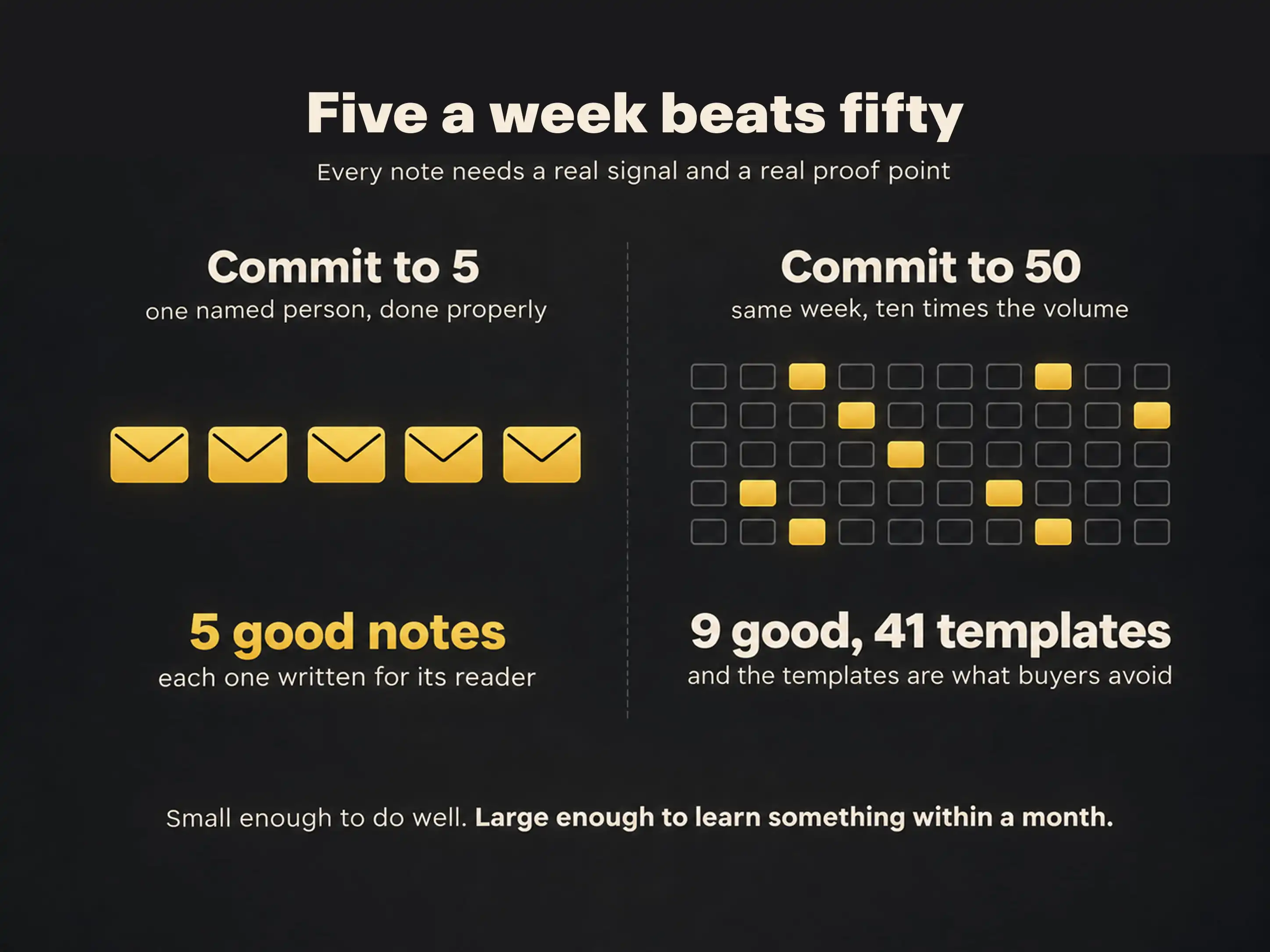
Start at five a week, done properly, by one named person.
Five is small enough that every note gets a real signal and a real proof point, and large enough to learn something within a month. A firm that commits to fifty sends nine good ones and forty-one templates.
If a contact does not reply, wait at least a quarter before reaching out again. If one signal was not reason enough to reply, a second three weeks later is pressure, not relevance.
When somebody replies, do not pivot immediately into the pitch. Take time to chat about the signal you used to write them. You earned a reply because you wanted to talk about something important to them.
How to run this at scale without it becoming spam
Doing this by hand works, but it does not scale. One person can research maybe ten contacts properly in a morning, which is fine for ten and useless for hundreds.
What scales is the watching. Monitoring several hundred contacts is a machine job. Deciding which signal matters, and what to say about it, is not.
That is the split we built into our own operating system: it finds the signal and drafts the note in the relationship owner’s voice, grounded in the actual history. A person reads it, changes it, and sends it. Nothing goes out unsigned, because the moment it does, it becomes the irrelevant outreach that 73 percent of buyers avoid.
The test of whether that split works is whether the notes still sound like the firm. John Flynn, President of JF Consulting, said after running it:
“The work doesn’t feel like generic outreach. It sounds like us. Our brand, our voice, and the actual work we do are reflected in every interaction.”
When reactivation is not your problem
While every firm could benefit from improving their reactivation strategy, there are some instances where these strategies will not be any help.
Skip this if:
- Your CRM has fewer than a few hundred contacts. Build the relationships first.
- The relationships ended badly. Reactivation restarts quiet relationships, not damaged ones. A signal does not fix a bad ending.
- Nobody will own the sending. This is the common one. The list gets built, the signals get found, and nothing goes out because it is nobody’s job. A reactivation program with no owner produces a very well-researched spreadsheet.
The relationship did not end. The conversation did. Pick that conversation back up with signals.
FAQ
Anything dated, public, and specific to that person or firm. A promotion, a funding round, a new office, a senior hire, an acquisition, an award. The test is whether it changes what they need, not whether it is newsworthy.
Stop replying on the old thread and wait for something to change in their world. Open with that, connect it to a result you have delivered, reference the earlier conversation in one line, and make one short ask.
A note that opens with something that just happened to them. A check-in asks the reader to supply the reason for the conversation. A signal-based note supplies it, which is why one gets replies and the other does not.
Usually, and by a wide margin. Around 70 percent of professional services revenue comes from people the firm already knows (Mabbly research across 500 firms), and a warm contact converts at a multiple of a cold one.
There is no expiry date, because the trigger is not elapsed time. It is whether something changed that makes the conversation relevant now. The odds do fade: healthcare data puts reactivation at 25 to 35 percent inside a year of silence and under 8 percent past two years, so sooner beats later.
Five, done properly, by one named person. Every note needs a real signal and a real proof point, and volume is what turns the program into the irrelevant outreach buyers avoid.
The watching, yes. The judgment, no. Monitoring hundreds of contacts for signals is a machine job. Deciding which signal matters and what to say about it is not, and nothing should go out without a person signing it.
References
- Gartner, B2B buyer survey, 2025
- Dialog Health, patient reactivation statistics, 2025
- Mabbly research across 500 firms
- Mabbly, The Method: https://www.mabbly.com/method

Where does your firm actually stand?
Five questions, ninety seconds. The Growth Gap Assessment scores your growth engine and returns next steps in your own numbers.
Or start with one relationship. The free first wake finds a signal on a contact who has gone quiet and drafts the note:
https://www.mabbly.ai/


