
Many firms that go looking for a rebranding consultant do not have a brand problem. These firms think a new logo and a fresh coat of paint on their social platforms can solve their lead generation problems and help them close deals. But chances are, these firms actually have a positioning problem, and a new logo won’t change that.
A rebrand changes what the firm looks like. A repositioning changes what the firm is for, who it serves, and why anyone should choose it. One is design work. The other is a decision.
We have watched firms ship a handsome new identity over an unchanged position, then wonder why their pipeline did not move.
What does a rebranding consultant actually do?
A rebranding consultant redesigns how a firm presents itself: the name, the logo, the colors, the typography, the messaging, and the templates that carry them. The output is a brand system and a set of guidelines for using it.
Rebranding work is incredibly valuable, which is why we help companies recreate or elevate their look. A name that no longer fits, an identity built for a smaller company, four sub-brands nobody can tell apart, a merger with two logos on one door—these are problems for a rebranding consultant.
What a rebranding consultant does not do is decide what the firm sells, to whom, and against whom. That is brand positioning.
Rebrand or reposition: how to tell which one you need
| A rebrand | A repositioning | |
| Changes… | How you look and sound. | What you sell, to whom, and why they choose you. |
| Starts with… | Your identity. | Your market. |
| Fixes… | A brand that no longer fits your firm. | A firm that’s competing on the wrong ground. |
| Delivers… | A logo, color palette, typography, and brand guidelines. | A written positioning statement your whole company can repeat with confidence. |
| Fails when… | The position underneath it is wrong. | Nobody makes any changes to how they work and talk about the company. |
| Is bought from… | A brand or design studio. | A strategy studio or consultancy. |
Want to figure out if you need a rebrand or a repositioning? Ask yourself one question:
What makes your firm, its services, and its approach different from the rest of the competition?
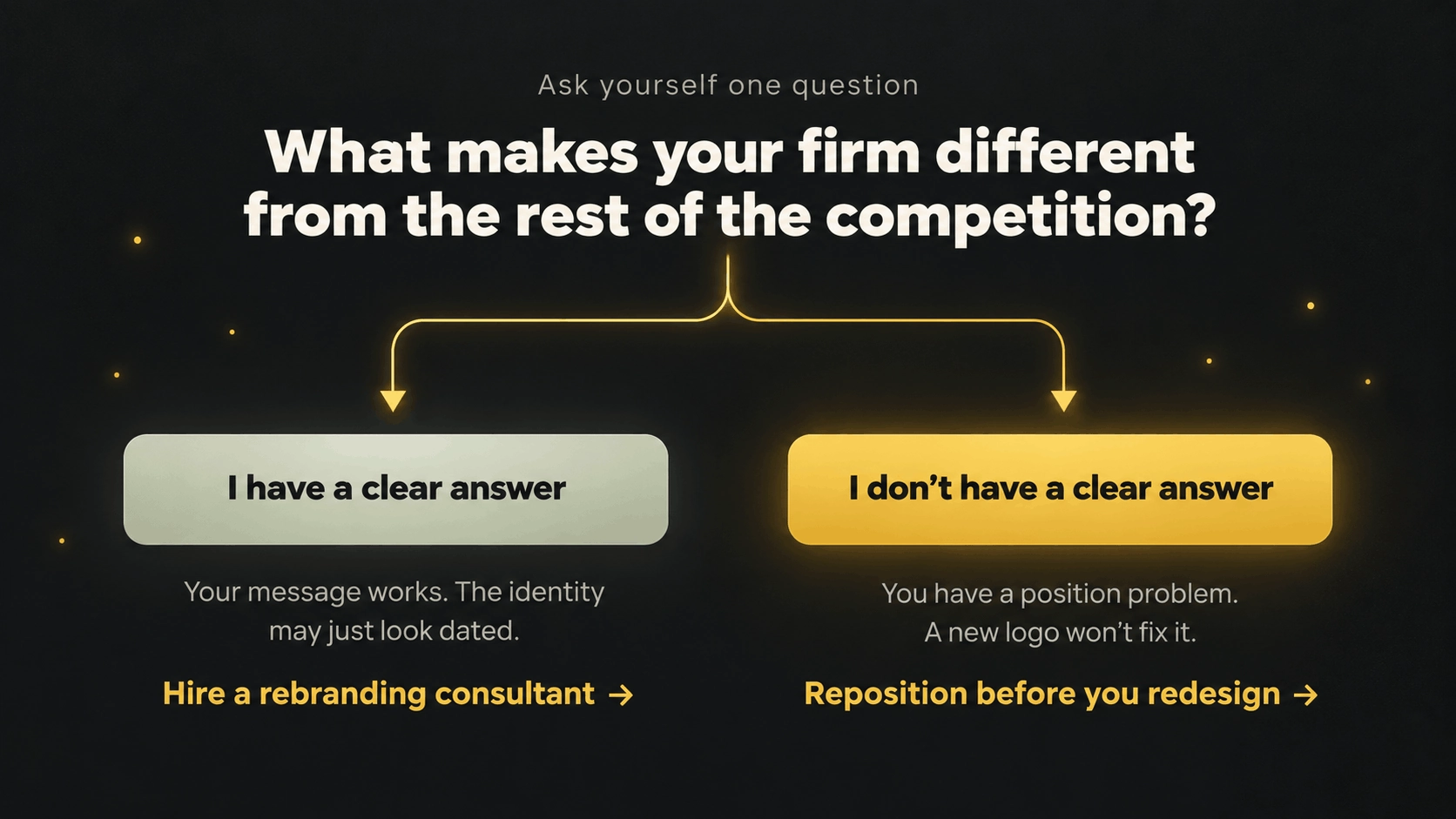
If you have a clear answer, whether it stems from your experience, your market niche, or your proprietary strategies, then you may have a great message with an identity that looks like it came out during the Bush administration. If you don’t have a clear answer, you should figure that out before touching your logo.
When do you need a rebranding consultant?
You need a rebranding consultant when the identity has fallen behind a firm that is otherwise working. Four situations qualify.
- A merger or acquisition. Two firms, two identities, one entity. Somebody has to decide what the combined firm is called and how it looks.
- The name no longer fits. The firm is named after a service it stopped selling, a founder who left, or a city it outgrew.
- Sub-brand sprawl. Four practice areas with four visual systems, and a buyer cannot tell they are the same firm.
- The identity is genuinely dated. Not unfashionable. Dated to the point where a buyer assumes the firm is smaller or older than it is.
In all four scenarios, the firm already knows what it sells and to whom. That is what makes them brand problems.
Should you do a rebrand in-house instead?
The honest answer depends on two things: whether the team has the skills, and whether they have the hours.
Most in-house creative teams are small and have gaps in their skill set. A designer who is excellent at layouts and has never built a brand architecture. A marketer who writes well and has never run a rollout across a website, a proposal deck, and a sales team at once. A rebrand needs both, at the same time.
The second constraint is the one that actually kills it: The average rebrand takes around seven months (Bynder, 2023). That is seven months of project work landing on people who already have a full week.
There is also an argument for outside eyes. A team that sees the brand every day struggles to judge it, and the people closest to a firm are usually the worst at describing what makes it different.
None of which changes the diagnosis. If the position is wrong, doing the rebrand in-house produces the same wrong answer more cheaply.
What a rebrand alone will not fix
As we’ve already stated, a rebrand fails when the underlying position hasn’t changed. The firm looks different and says the same thing, so buyers hear the same thing.
AArete is a useful example because the firm bought both. In 2019 the management consulting firm ran a comprehensive rebrand: new logo, new tagline, new website. The visual work was real, and it shipped. But what moved the business was the position.
The firm had been competing on general consulting capability, against everyone else competing on general consulting capability, and the repositioning changed the ground it competed on. Three years later, revenue had grown from $17M to $76M. Check out the full story.
What does rebranding cost?
Published benchmarks cluster in roughly the same place, and scope moves the number more than anything else.
- $5k to $25k for a visual refresh. Logo, palette, typography, light guidelines (MTHD, 2026).
- $20k to $75k for a small firm rebrand with strategy attached. Positioning refinement, a visual identity system, essential templates (Ramotion, 2026).
- $50k to $250k for a mid-market firm, roughly $10M to $100M in revenue. Identity, messaging, architecture, and rollout (MTHD and Ramotion converge here, 2026).
- $150k to $350k once the website and full rollout are included at that size (Ignyte Brands cost analysis, cited in MTHD, 2026).
Expect the quote to be the floor. Website updates, collateral, trademark work, and content typically add 20 to 40 percent on top (Big Red Jelly, 2026).
A repositioning is priced differently because it is different work. It starts with a market decision and a written position, and it can take just weeks rather than months.
Why rebranding pricing is splitting in two
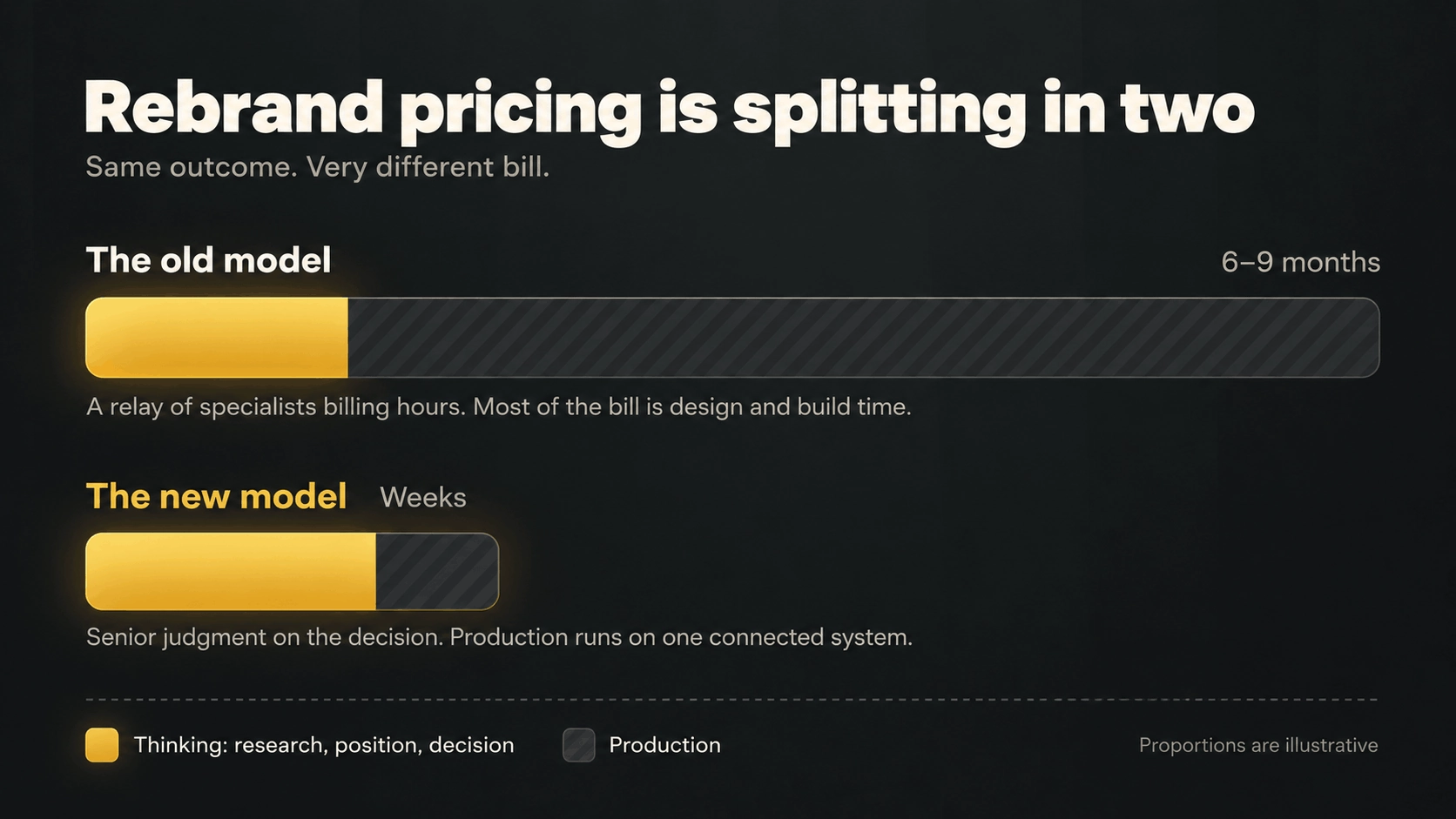
The benchmarks above are old-model prices, and it is worth understanding what they are made of, because the model underneath them is changing.
| The old model | The new model | |
| What you buy… | Deliverables, files, and guidelines handed over at the end. | An outcome, the position live on every surface. |
| Who does the work… | A relay of specialists billing hours to each other. | Senior judgment on the decision, with production run on one connected system. |
| How long it takes… | Six to nine months, most of it production. | Weeks, most of it strategy. |
| Where the money goes… | The majority of the bill is design and build time. | The majority is the thinking, the research, the position, the decision. |
| What to watch for… | Handcraft rates for work that software now does. | A provider who cannot show the system running on their own firm. |
We can describe the new model because we run it. Our own repositioning shipped on the same system we build for clients: production in weeks, with the senior time spent where it pays, on the position. Ask any provider quoting 2023 prices a simple question: which part of this bill is thinking, and which part is production billed at handcraft rates?
How to rebrand a professional services firm
Professional services firms get this wrong more often than product companies for a specific reason: The firm grew on relationships, so nobody ever had to decide what it was for. Referrals arrived carrying their own context, and the identity never had to do any selling.
Then the referrals flatten. The firm lands in what we call the Growth Gap. You’ve outgrown referrals but haven’t built the growth engine that comes next. The instinct at that moment is to look at the website, because the website is visibly old and a website can be fixed.
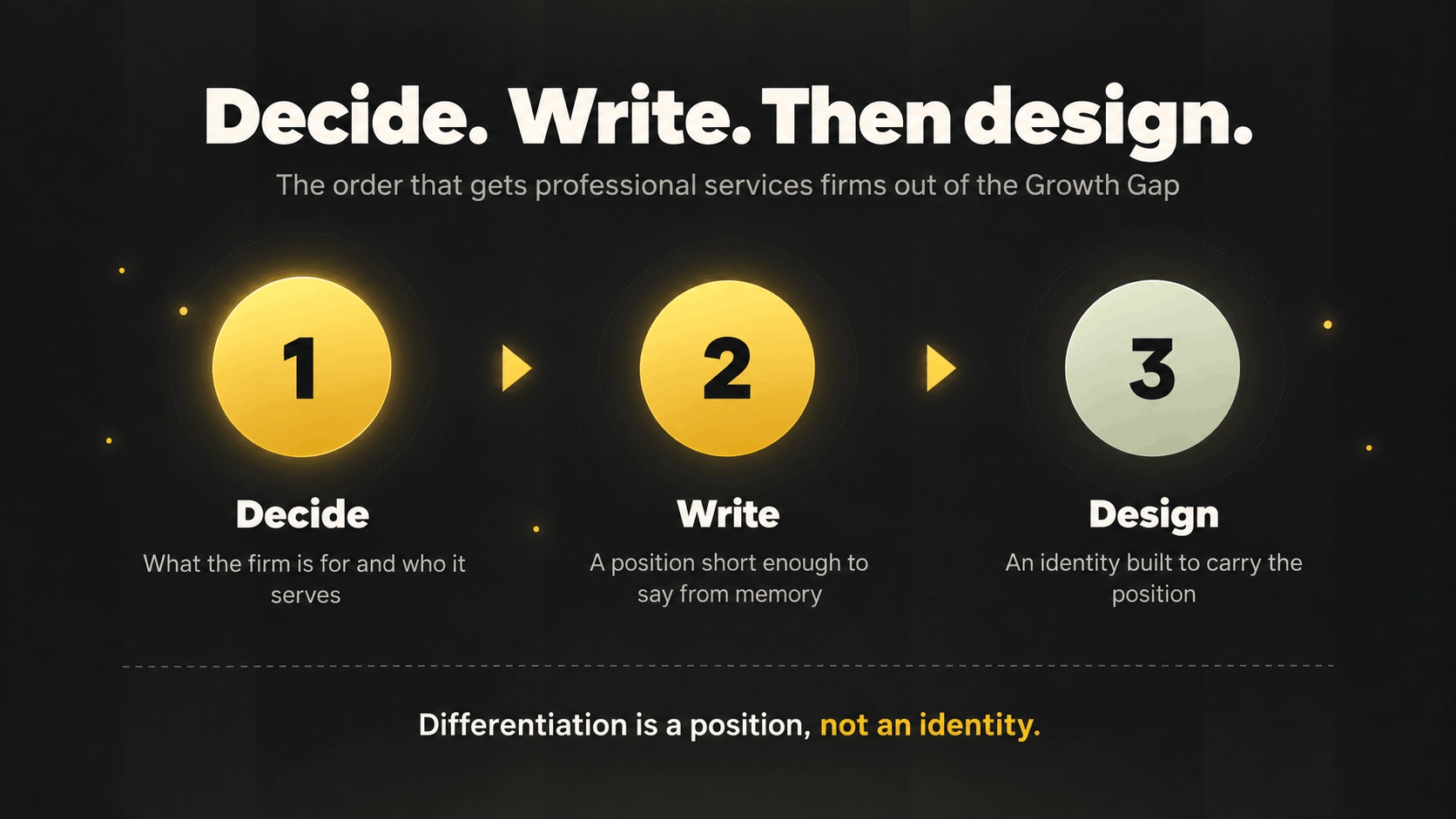
In the 500 firms we studied for the Growth Gap thesis, we found the firms that break the plateau are not the ones with the newest identity. They are the ones that decided what they were for, wrote it down, and made every channel carry it.
Differentiation is a position, not an identity. Which is why the order runs: decide the firm’s purpose and niche, short enough to say from memory. Write the position. Then open a design file. That sequence is what a go to market agency owns, and it is the part a design studio is not hired to do.
When neither is your problem
If you’ve made it this far into the article and nothing we’ve written has resonated with you, congrats! Your firm is likely in great shape. Feel free to skip both a rebrand and a repositioning if:
- Referrals still fill the pipeline and the partners are not worried. A rebrand at that point is an expensive way to feel busy.
- You have one weak channel, and you know which one. Hire a specialist for that channel. It costs less, and it works.
- The last rebrand was under three years ago. Buyers have barely learned the current identity. Changing it again resets recognition you already paid for.
A rebrand is not a growth strategy. It is what you do to an identity once the growth strategy is decided.
The question that settles it
Ask three people separately: a partner, your newest hire, and your best client. Ask each what makes the firm different.
Three different answers means a position problem. No consultant can design that away, because the problem is not what the firm looks like. It is that the firm has never agreed on what it is.
The same answer three times, and it simply looks dated? Hire the rebranding consultant.
FAQ
Rebranding changes how a firm looks and sounds. Repositioning changes what it sells, to whom, and why they should choose it. Rebranding is design work built on a decision. Repositioning is the decision.
When the strategy is settled and the identity has fallen behind it. A merger, a name that no longer fits, sub-brand sprawl, or an identity dated enough that buyers misjudge the firm’s size. If you cannot state what the firm sells and to whom in one sentence, that comes first.
Published benchmarks run from about $20k for a small firm to $350k for a mid-market firm with full rollout, plus 20 to 40 percent for collateral and content. Treat those as old-model prices: they are built on months of production that connected systems now do in weeks, so the useful question is how much of a quote is judgment and how much is production.
Rarely on its own. A rebrand restates a position more attractively. If the pipeline is flat because the firm competes on the same ground as everyone else, buyers hear the same thing in a nicer font. Fix the position first, then decide whether the identity still needs work.
Decide the position before the design. Agree what the firm is for and who it serves, write it in a sentence the whole firm can repeat, then build the identity to carry it. Firms that do it the other way around usually redo the work.
For the production, yes. Design systems, website builds, and rollout now take a fraction of the time they did two years ago, and the price should reflect that. For the judgment, no. Deciding what the firm is for, who it serves, and why anyone should choose it is senior human work, and it is the part worth paying for. The warning sign is a provider whose process got faster and whose prices did not.
References
- Bynder, 2023
- MTHD, 2026
- Ramotion, 2026
- Ignyte Brands, cited in MTHD, 2026
- Big Red Jelly, 2026
- PRNewswire, November 2019 (AArete rebrand announcement)

Where does your firm actually stand?
Five questions, ninety seconds. The Growth Gap Assessment scores your growth engine and returns next steps in your own numbers.
Or watch the 2 minute walkthrough first:
https://www.youtube.com/watch?v=7fJmlLJOEv4


