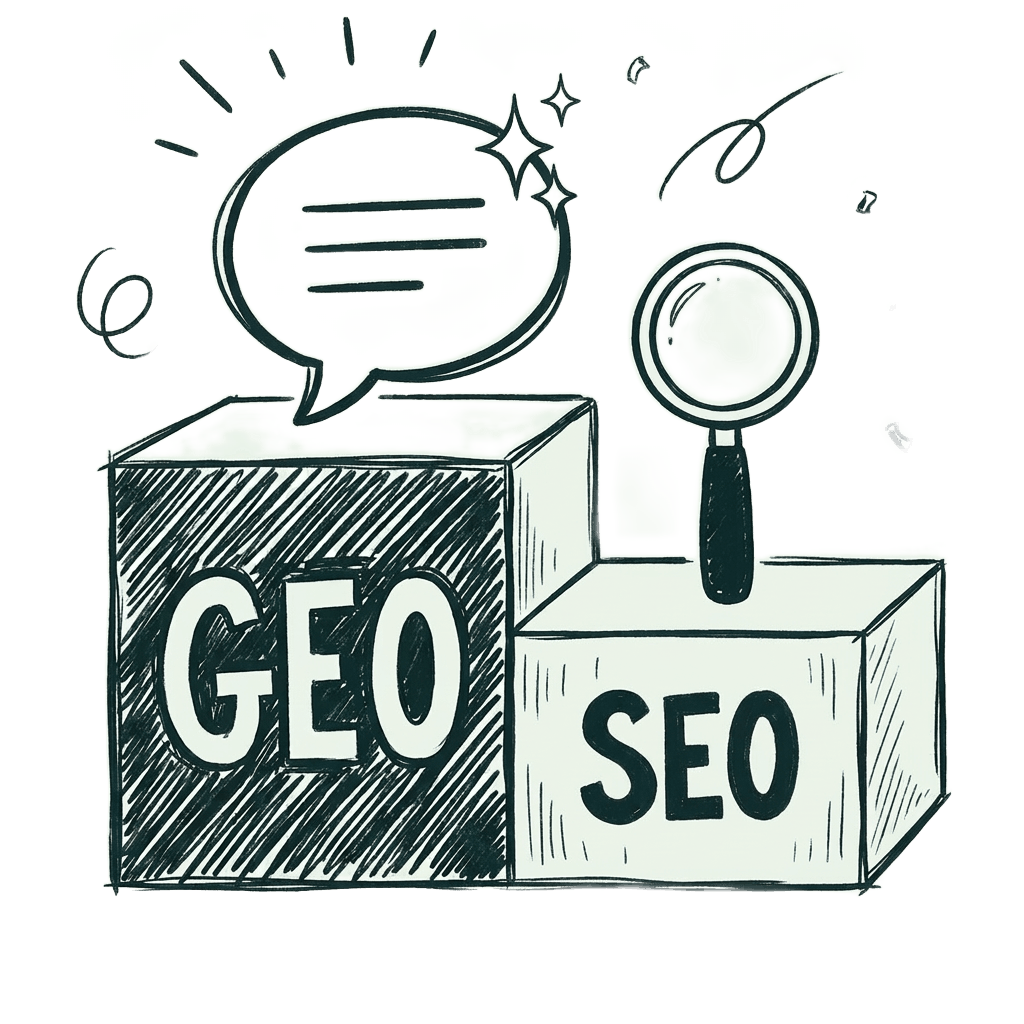
No, GEO (generative engine optimization) is not replacing SEO. But how people discover your content has changed.
Your page still ranks. The answer the reader is looking for still comes from your content, but the reader never arrives on your website. You can be the source of the answer and never meet the person who asked the question.
We’ve experienced the same on our own website. And, frankly, the numbers are not flattering.
How GEO is affecting traffic, based on Mabbly’s own data
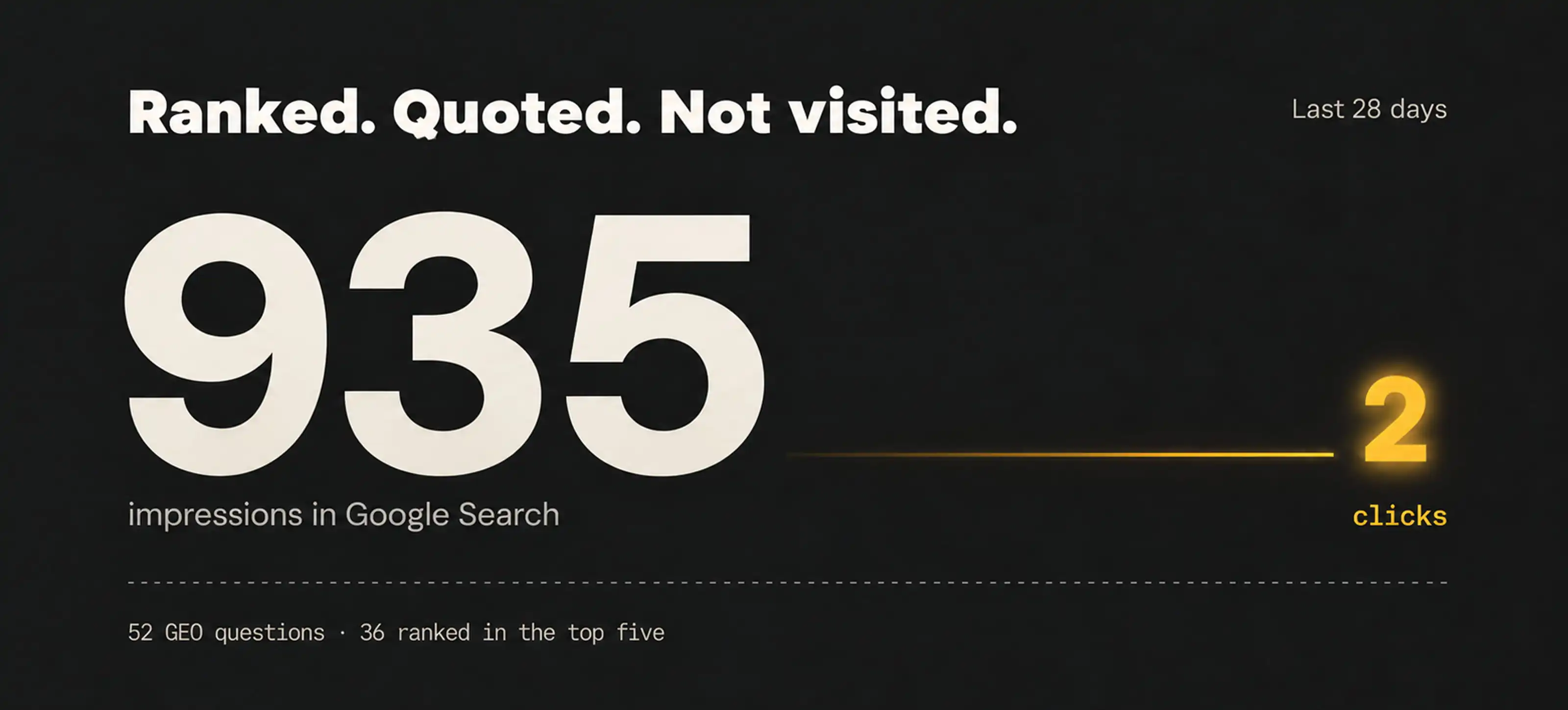
In the last 28 days, Mabbly appeared in search results for 52 questions about GEO. Those queries produced 935 impressions. And two clicks.
Of those results, 36 of the 52 rank in the top five. We sit at position 3.8 for “is geo replacing seo,” which alone drew 223 impressions, but zero clicks. The article carrying those rankings has 1,703 impressions and five clicks, a click-through rate of 0.29 percent.
Meanwhile, Google’s own Generative AI report shows this page earned 2,815 impressions inside AI features over the last 90 days, roughly thirty appearances a day. About 30 percent of our entire site’s AI visibility stems from one page.
We wrote the page about GEO. We rank near the top of page one for the questions it answers. Almost nobody clicks because they get their answers from the machines instead.
Ranking and being read used to be the same thing. They are not anymore.
What is generative engine optimization?
When a buyer asks an AI assistant a question, a model writes the answer by reading and citing several pages. The practice of making sure your firm is among the sources that answer is called generative engine optimization, or GEO.
The term comes from a 2024 paper by researchers at Princeton, IIT Delhi, Georgia Tech, and the Allen Institute, who defined the problem and built the first benchmark for measuring it (Aggarwal and colleagues, ACM SIGKDD, 2024).
What is the difference between SEO, AEO, and GEO?
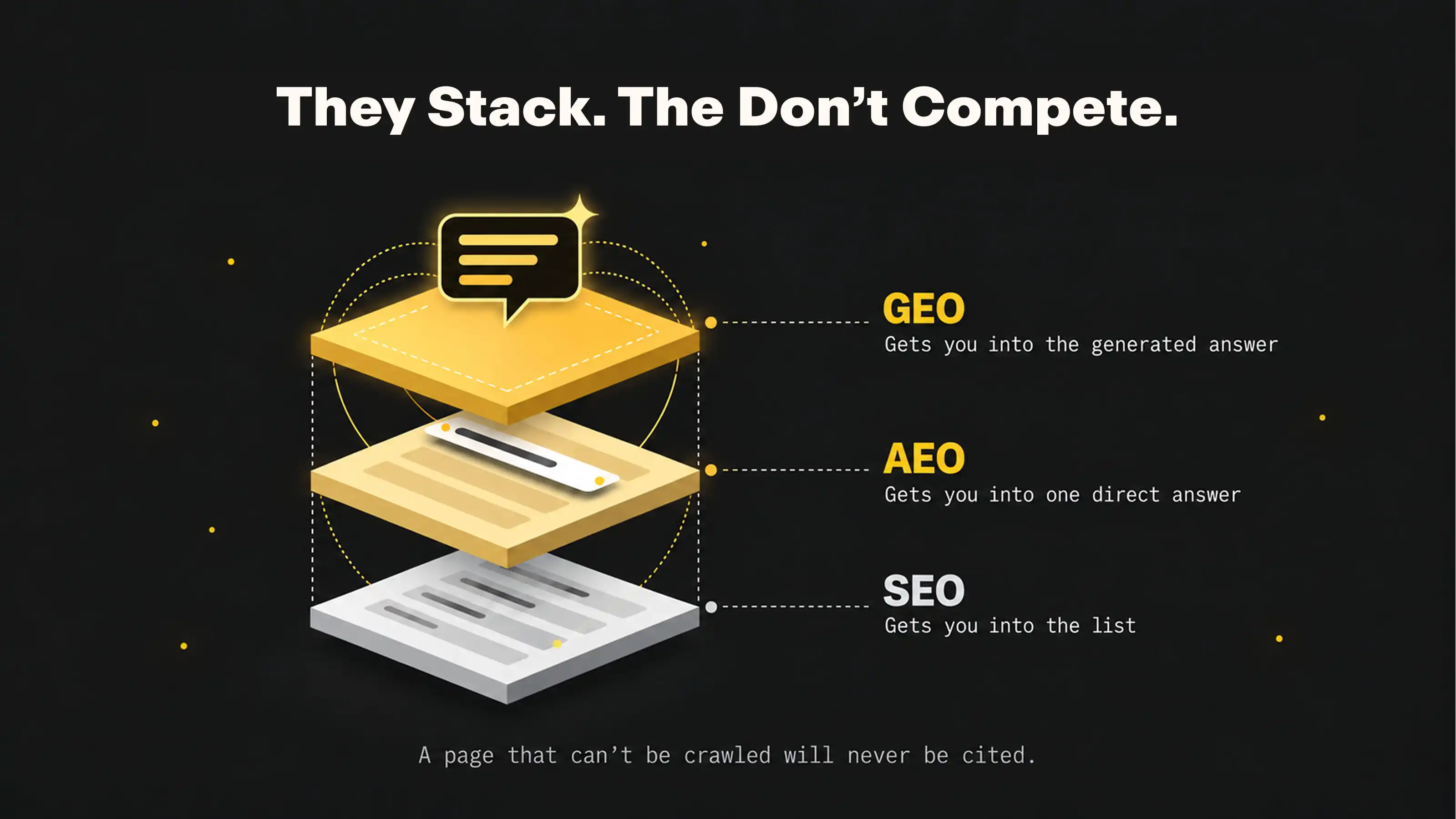
People often use these terms synonymously, but they have distinct roles. SEO gets you into the list, AEO gets you into a single direct answer, GEO gets you into a summarized answer.
| SEO | AEO | GEO | |
| Targets | A position in a list of links | One direct answer, such as a featured snippet | A generated answer assembled from several sources |
| Success is | You rank | You are the answer | You are cited inside the answer |
| It needs | Crawlable, indexed, relevant | Clear structure and one clean answer | Quotable claims, sourced numbers, defined terms |
| Who reads it | A person, after clickingRank | A person, usually without clicking | A model first, a person second |
SEO, GEO, and AEO do not compete. If anything, they complement one another. A page that cannot be crawled will never be cited, so SEO remains essential. AEO and GEO are needed to take your page further.
Will GEO eventually replace traditional SEO?
GEO will not replace SEO as a discipline. But site traffic, the thing firms were buying when they bought SEO, has already started moving.
Forrester found that 94 percent of business buyers now use AI in their buying process, and that twice as many buyers named generative AI or conversational search their most meaningful research source than any other named source, ahead of vendor websites, product experts and sales (Forrester, January 2026).
Read our click-through rate again with that number beside it. Two clicks from 935 impressions is not a content quality problem. It is what zero-click buying looks like on a firm’s own analytics.
It also moves the decision earlier. 6sense found that 94 percent of buying groups rank a preferred vendor before first contact, and buy from that early favourite 77 percent of the time (6sense Buyer Experience Report, November 2025).
If the shortlist is built before the first visit, traffic was never the number that mattered.
How does keyword strategy change when moving from SEO to GEO?
Keywords should stop being a list of terms and become a list of claims a model can lift from.
This is measurable rather than theoretical. The team that named GEO tested nine content changes across 10,000 queries and found that adding statistics, quotations, and cited sources raised a page’s visibility in generated answers by up to 40 percent. Keyword density, the classic SEO signal, had almost no effect on whether a page was cited at all (Aggarwal and colleagues, ACM SIGKDD, 2024).
Three things change in practice.
- Answer first, explain second. The paragraph under each heading has to answer that heading in two or three sentences. A model lifts the first answer it finds, not the best one buried six paragraphs down.
- Numbers with attribution. A statistic with a named source and a year is quotable. The same statistic without one is not, and an invented one is worse than none.
- Definitions in one line. Describe the thing, then name it. That is how a model learns to associate your firm with a concept you created rather than with the competitor who defined it more clearly.
Why this hits professional services firms hardest
The best thinking inside a consulting, legal, or accounting firm lives in proposals, pitch decks, partner emails, and conversations. All of that is private.
In other words: your expertise is real, and almost none of it is written down anywhere a model can reach.
When a managing partner asks an assistant who to hire, the answer is assembled from firms whose expertise is public and structured. But “the most legible firms” does not mean “the best firms”.
The fix is not more content. It is a written record of what the firm actually believes:
- Who it serves
- What it sells
- How it sounds
- What it will never say.
One source of truth that every person and every model can read. That record sits at the centre of the go to market operating system we publish free and run on ourselves. It is the same reason a go to market agency owns one story across every channel: the machines reward the coherence.
A firm that has never written that down cannot be quoted, no matter how good it is. Most firms in this position are living the same pattern we call the Growth Gap: you’ve outgrown referrals, but haven’t built the growth engine that comes next. Being absent from AI answers is what that gap looks like in 2026.
What it costs to fix
Now you’re probably wondering how to fix this. Here are some to-do items that can get your GEO strategy up and running (as well as how much time it should take you to complete these tasks).
- Run the visibility test. One afternoon, no budget. Ask ChatGPT, Claude, Perplexity, and Google AI Overviews the ten questions a buyer asks before hiring a firm like yours. Score each answer three ways: cited with a link, mentioned without one, absent. That is your baseline.
- Rewrite the openings on pages you already rank for. About 30 minutes per page. Make the first paragraph under every question heading answer that question. Most firms do not need new pages. They need the first paragraph of the pages they have.
- Write a real FAQ block, and skip the schema debate. About an hour per page. Google stopped showing FAQ rich results in search on May 7, 2026, so the expandable dropdown you may remember is gone (Google Search Central, 2026). The block itself still matters, and more than it did, because a tight question and answer pair is exactly the shape a model lifts. Write the FAQ for the model, not for the search result.
- Publish something only you know. Months, and it is the only one nobody can copy. A model cannot assemble a number that exists nowhere else. Our study of 500 firms is the reason we can write sentences other agencies cannot.
When GEO is not your problem
GEO may not be the biggest thorn in your side. Skip all of this if:
- Referrals still fill the pipeline, and your partners are not worried.
- Your buyers are a closed market of a few hundred people who already know you by name.
- Your pages do not rank at all yet. This is the common one. GEO built on top of nothing is nothing, because a model cannot cite a page it never found. If you are on page four, that is an SEO problem.
For us, GEO was a problem. Two clicks from 935 impressions is not a good result, especially for a firm that does this for a living.
If it is happening to us, on the page we wrote about this exact topic, it is definitely happening on pages you have not looked at in a year.
We publish our entire operating system free, and we run it on ourselves before we run it on a client. Check out how we can build one for you to transform your go to market.
FAQ
GEO, or generative engine optimization, is the work of making a firm’s expertise legible to AI systems so it appears inside generated answers rather than only in a list of links. Traditional SEO is measured by position. GEO is measured by citation.
AEO, answer engine optimization, targets a direct answer pulled from one source, such as a featured snippet. GEO targets a generated answer synthesized from several sources at once. AEO asks to be the answer. GEO asks to be one of the sources the answer is built from.
No. Classic search still drives discovery, and AI engines learn who to trust largely from what already ranks and earns links. What died is content written for bots: AI answers filter it out even more aggressively than rankings did.
It can draft, outline, and analyze usefully. What it cannot supply is what GEO rewards: original data, a named expert with a real footprint, and one consistent story everywhere. Tools accelerate the work; they are not the work.
No. A model cannot cite a page it has not found, so a site that does not rank has an SEO problem first. Fix crawlability, indexing and relevance, then make the pages quotable.
Not on its own. Google stopped showing FAQ rich results on May 7, 2026 and says no special markup is required for its AI features (Google Search Central, 2026). What gets cited is a clear answer on the page, not the code wrapped around it.
Because the behaviour moved in a single year. 6sense found that 94 percent of buying groups rank a preferred vendor before first contact and buy from that early favourite 77 percent of the time (6sense, November 2025). The shortlist is assembled before anyone visits a website.
References
- Aggarwal et al., GEO: Generative Engine Optimization, ACM SIGKDD 2024 — https://dl.acm.org/doi/pdf/10.1145/3637528.3671900
- 6sense, 2025 Buyer Experience Report (Nov 2025) — https://6sense.com/science-of-b2b/buyer-experience-report-2025/
- Forrester (Jan 2026) — https://www.forrester.com/blogs/b2b_buyers_make_zero_click_buying_number_one/
- Google Search Central, FAQ structured data documentation (2026) — https://developers.google.com/search/updates#removing-faq-rich-result
- Gartner, The B2B Buying Journey — https://www.gartner.com/en/sales/insights/b2b-buying-journey

Where does your firm actually stand?
Five questions, ninety seconds. The Growth Gap Assessment scores your growth engine and returns next steps in your own numbers.
Or watch the 2 minute walkthrough first:
https://www.youtube.com/watch?v=7fJmlLJOEv4


